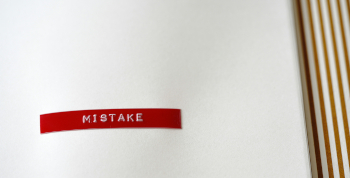
 No one enjoys making mistakes.
Some of us actively fear making mistakes.
It’s understandable, of course. Practically from the time we pop out of the womb, we’re told we’re supposed to be right. To know the answers. To never fumble the ball, literally or figuratively. And depending upon our family, community, teachers, bosses, peers, we may be further terrorized by the level of their displeasure when – not if – we make a mistake.
In writing that, I find myself almost losing the point I want to make in the face of so many reasons not to be wrong – to always be right.
But there’s value in them thar mistakes.
Clearly not in the ones that create real catastrophes. No one wants to be remembered as the software engineer who left out a symbol in the code for the Mariner 1 mission back in 1962, causing it to veer off course and be destroyed. No one wants to be the doctor whose mistake causes a patient to die.
But then we have the discovery of penicillin, which came from a moldy petri dish that biologist Alexander Fleming mistakenly left uncovered overnight. And the discovery of sticky notes, formally known as Post-Its, which started from an effort to create an especially strong adhesive. Oops.
Or not oops. Penicillin has saved countless lives. And I can’t imagine an office without at least one pad of sticky notes. People have planned entire projects – big projects – by moving stickies around on a board.
Are you – or I – going to make mistakes as fortuitous as those? Probably not.
But as leaders, the mistakes we make can be remarkably instructive and even motivating to our teams. Being overly cautious is not a trait that leads to real success; instead, it hampers forward motion and often causes people to hide the mistakes they make instead of bringing them forward for analysis and correction before they metastasize.
As leaders, when we’re up front about the mistakes we make, the times we’re wrong, and the ways in which we learn from that and fix what went awry, we demonstrate that yes, mistakes happen, and no, they’re seldom catastrophic.
And that means your people will be much more willing to acknowledge their own mistakes and the things that went wrong. They’ll be more proactive about bringing those errors forward so they can be addressed and learned from.
I’d suggest that this is the truest form of psychological safety: the ability to accept, correct, and learn from being wrong.
NOTES:
Photo by Daniela Holzer on Unsplash
Article on the Mariner 1 failure: https://science.nasa.gov/mission/mariner-1/
Wikipedia entry on Alexander Fleming: https://en.wikipedia.org/wiki/Alexander_Fleming
Post-It notes: https://www.post-it.com/3M/en_US/post-it/contact-us/about-us/
There are plenty of other examples: popsicles, potato chips, chocolate-chip cookies, Coke, Velcro, the Slinky, Play-Doh, microwaves, pacemakers, x-rays, Viagra (!), superglue, and more.